Open When Threatening, Hidden When Offering
Two letters from Apple, five months apart — vastly differing approaches to conduct they claim no liability for.
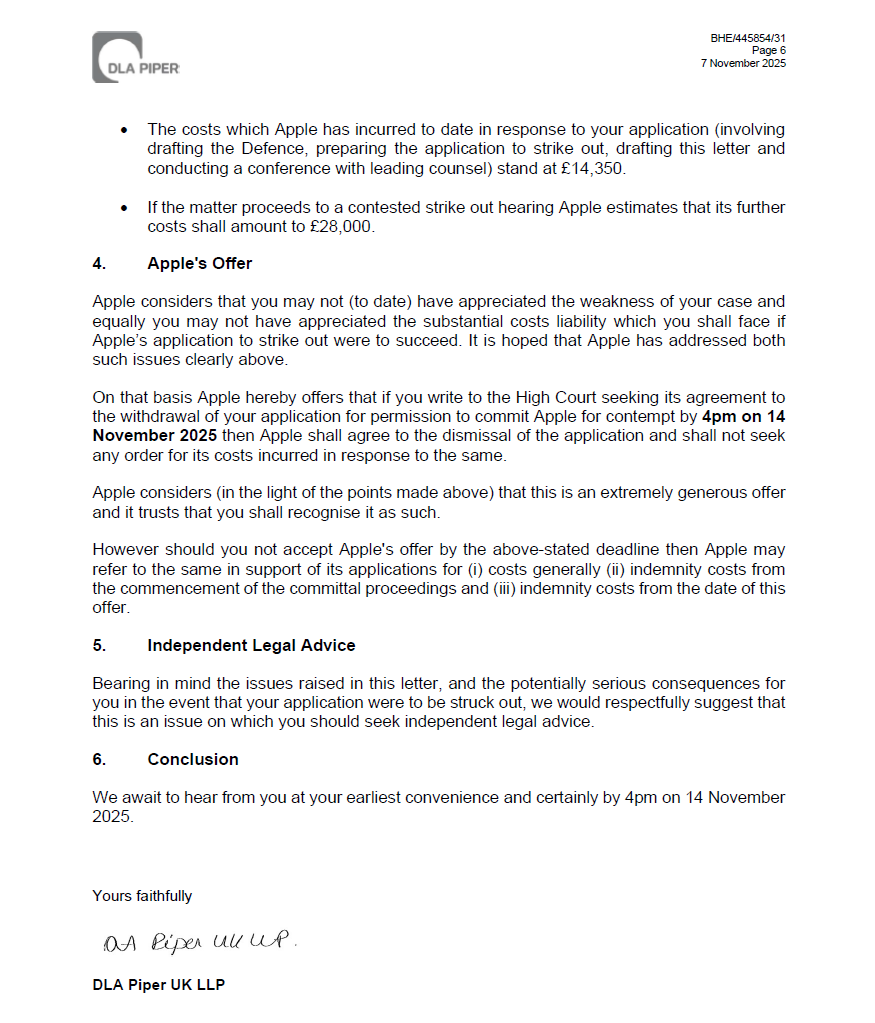
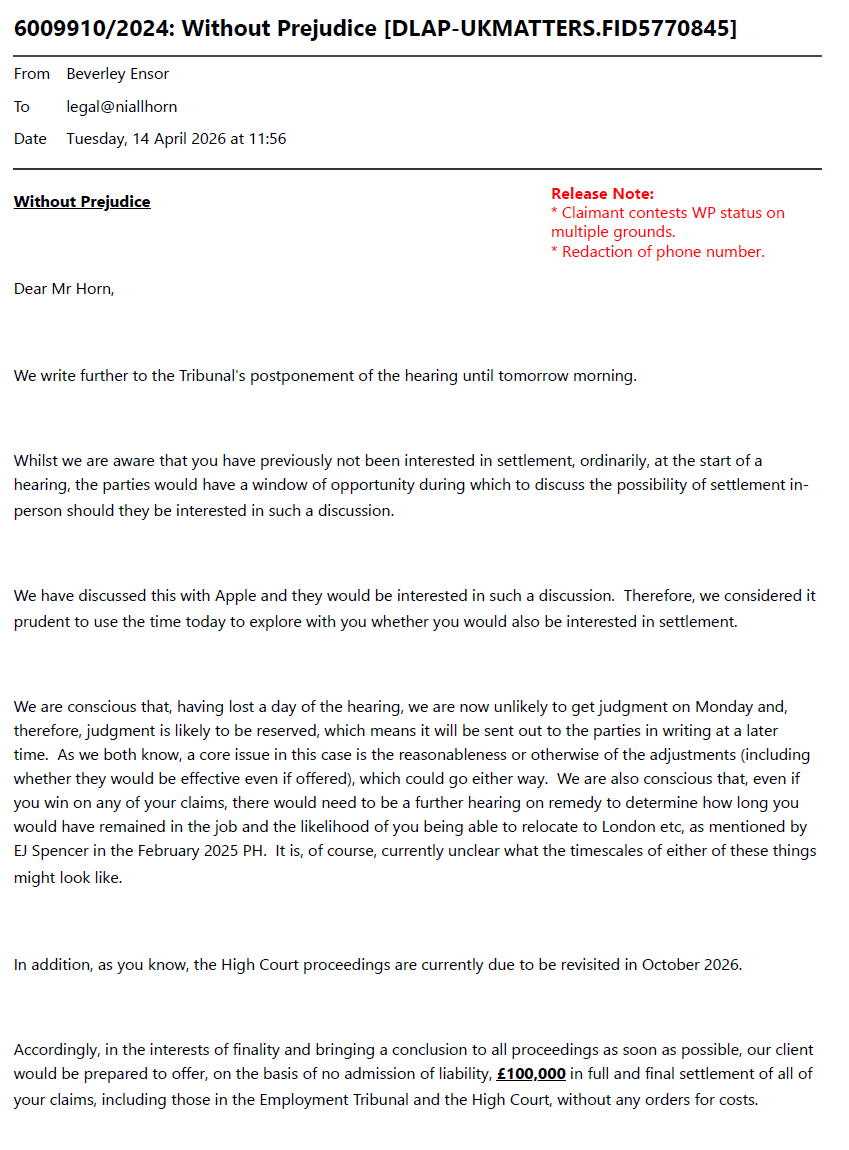
Open when threatening. Hidden when offering. I said no. Then they raised the offer. I said no again.
Put them side by side and the pattern is not subtle.
The first letter was written to be seen. It was intended for High Court proceedings, and it pursued me for £42,350 in costs — an amount that would bankrupt a litigant in person on disability benefits, which is what I am. Being seen was rather the point. A threat of that kind only works if you can hold it up.
The second was written not to be seen. It arrived marked ‘Without Prejudice’, the label that keeps correspondence out of the court’s sight, and it offered me £100,000 to go away. It arrived the day before the Employment Tribunal was due to hear the case in public. I allege that use of the label was an unambiguous impropriety: the privilege exists so that parties can negotiate frankly, not so that an offer of that size, made at that moment, can be kept off the record.
Five months separate the two. Same company, same case, same conduct it maintains it has no liability for. The only thing that changed in between was how close the matter had come to being heard in public.
The terms went further than the number. To take the £100,000 I would have had to drop both sets of proceedings, the Employment Tribunal claim and the High Court contempt application, from a company that five months earlier had been confident enough of success to pursue me for costs that would have bankrupted me. And as a settlement it was a poor one, even had money been the point. It is not, and it never has been. My position has not moved: Apple should apologise, and Apple should change how it recruits and accommodates disabled people; particularly those whose conditions are more bespoke, and who sit less comfortably in the branding than the ones it is willing to picture.
“In real terms, whilst we have not done the maths, this equates to roughly one years’ pay,”
— DLA Piper, for Apple
DLA Piper, Apple’s external lawyers, went on to accept that the arithmetic was poor. It was.
More to come. Artefacts coming.
Case background: Thinking Too Different — Apple 50 Years Later
Technical breakdown: Persona CoreIK visionOS Simulator Demo